❋
Neighborhood-Specific Waste Volume Estimates and Characterization
Highlights-
Develops estimates for waste generation and characterization 2010-2020 and reviews material-specific trends based on historical data, along with regional and national datasets
-
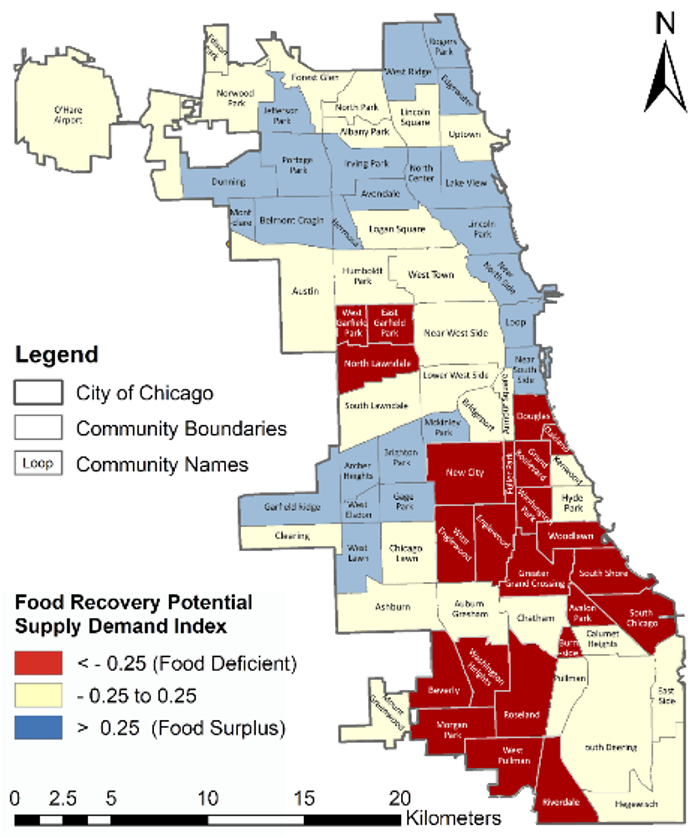
Develops a scalable model that is implemented in 77 communities in Chicago, adopted an inclusive approach that highlights the importance of engaging residents and small generators of food waste, illustrated the spatial disparities in food security
-
Dynamic inventory modeling and spatial matching to potential uses at the regional level
-
Illustrates sophisticated models may not lead to more precise inventory results, because the accuracy of waste estimation appears more constrained by data availability than by methodology
Selected PublicationsNing Ai and Junjun Zheng. 2019. Community-Based Food Waste Modeling and Planning Framework for Urban Regions. Journal of Agriculture, Food Systems, and Community Development. 9(1): 39-58. https://doi.org/10.5304/jafscd.2019.091.009
Ning Ai, Junjun Zheng, Matt Rundquist, and Taylor Gendel. 2021. Chicago Waste Generation and Characterization Update 2010-2020. Report submitted to the City of Chicago and Delta Institute on March 1, 2021. https://delta-institute.org/wp-content/uploads/2021/07/Characterization-Report-7.12.21.pdf?eType=EmailBlastContent&eId=7f683a8d-7f80-483a-93ef-bffda4a0a8d5
Ning Ai, Junjun Zheng, and Weiqiang Chen. 2019. U.S. End-of-Life Electric Vehicle Batteries: Dynamic Inventory Modeling and Spatial Analysis for Regional Solutions. Resource, Conservation, and Recycling, 145: 208-219. https://doi.org/10.1016/j.resconrec.2019.01.021
Nancey Green Leigh, Matthew Realff, Ning Ai, Steven French, Catherine Ross, and Bert Bras. 2007. “Modeling Obsolete Computer Stock under Regional Data Constraints: A Case Study in Atlanta.” Resources, Conservation, and Recycling, 51: 847-869. https://doi.org/10.1016/j.resconrec.2007.01.007